
Dog Deworming Guide: Treatment, Schedule and What to Expect
Deworming is one of the simplest, most effective things you can do for your dog's health — but the right product, dose, and schedule depend on age, weight, and which parasite is actually involved.

What Is Deworming, and Why Does It Matter?
Deworming is the process of eliminating intestinal and internal parasites from a dog's body, and it's considered as fundamental to routine care as vaccinations and flea and tick prevention. The right dewormer depends on your dog's age, weight, health status, and — most importantly — which parasite is actually involved, since no single product treats everything.
Left unaddressed, internal parasites can cause malnutrition, anemia, organ damage, delayed growth in puppies, and in the case of heartworm, potentially fatal heart and lung disease. Regular deworming isn't just about clearing a current infection — it's genuinely preventive care that protects a dog's long-term health.
What Is the Best Dewormer for Dogs?
There's no single "best" dewormer — the right choice depends entirely on which parasite is involved, which is why an accurate diagnosis matters more than picking a product off a shelf. Here's how treatment is typically matched to parasite type:
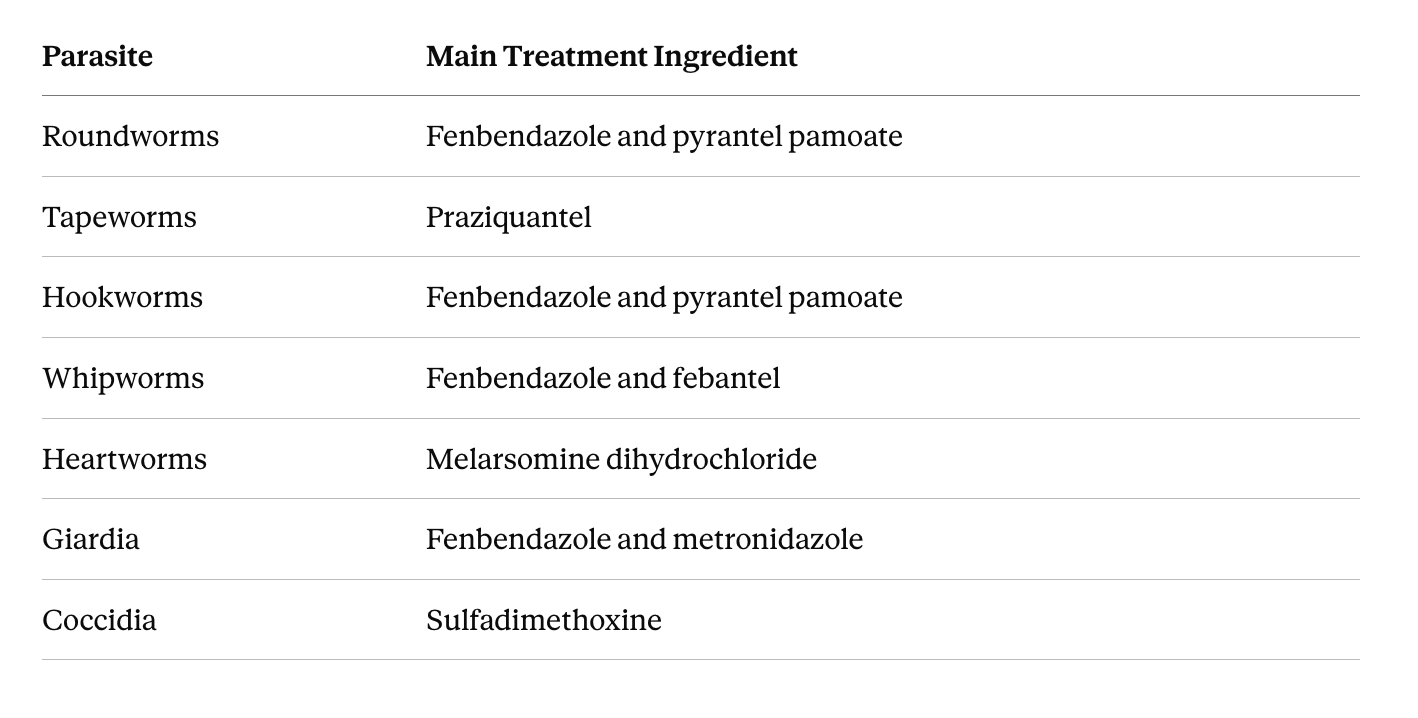
In the UAE, broad-spectrum products such as Drontal Plus, Milpro, and Caniverm are commonly used and cover several of these parasites in a single dose, but your vet will confirm the right choice based on your dog's specific situation rather than a generic recommendation.
Types of Deworming Medicine and How They're Given
Deworming medications fall into two broad categories: broad-spectrum dewormers that treat multiple parasite types at once, and targeted dewormers aimed at a single specific parasite. Which category makes sense depends on whether a specific parasite has been confirmed or whether broader preventive coverage is the goal.
These come in several forms, including chewable tablets, standard pills, topical (spot-on) treatments, liquids and pastes, and injections. The right form often comes down to your dog's preference and ease of administration as much as the medication itself — your vet can advise on what tends to work best for dogs who are difficult to pill.
Puppy and Adult Dog Deworming Schedule
Puppies should start deworming at 2 weeks old, repeated every 2 weeks until 12 weeks, then monthly until 6 months, after which adult dogs typically move to treatment every 3 to 4 months depending on lifestyle and exposure risk.
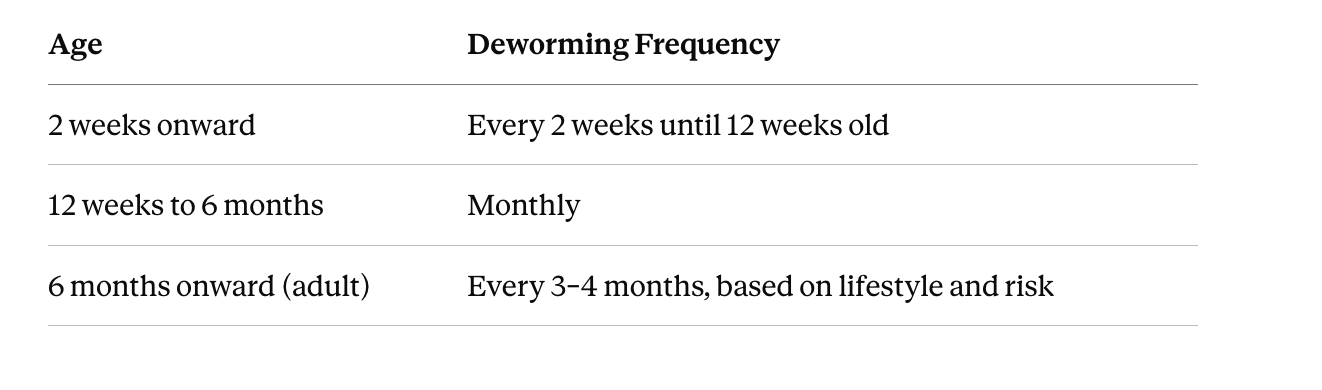
Puppies are especially vulnerable early on because their immune systems are still developing, and they can contract worms during birth or nursing from their mother. Adult dogs still need ongoing preventive treatment despite more developed defenses, and dogs with regular exposure to dog parks, daycare, boarding, or grooming facilities typically need more frequent treatment than dogs with minimal outside contact.
Types of Parasites and Their Symptoms
Different parasites cause noticeably different symptoms, which is part of why a fecal test matters more than guessing based on how your dog looks. Here's what to watch for by parasite type:
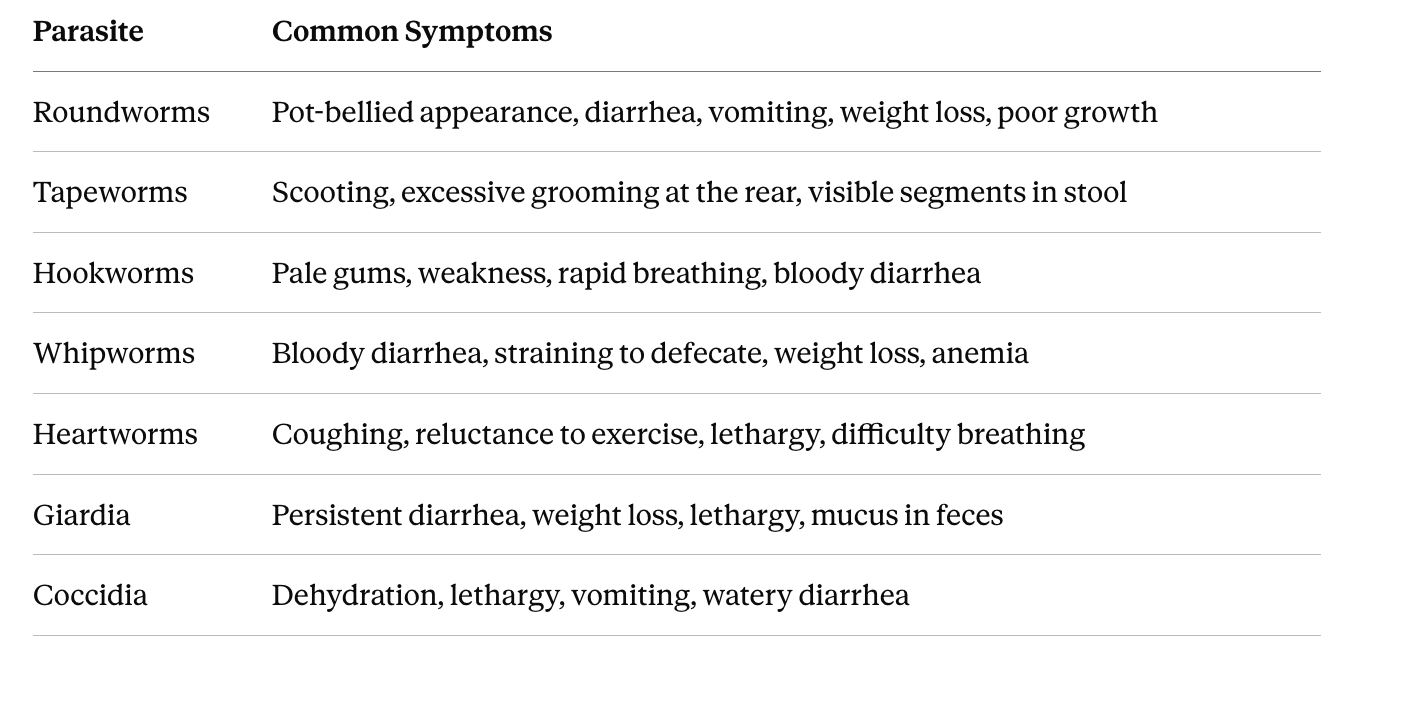
Many dogs with mild infections show few or no visible symptoms at all, which is exactly why regular preventive deworming and periodic fecal testing matter even when a dog seems perfectly healthy.
How Many Deworming Tablets Do I Give My Dog?
Dosage is calculated strictly based on your dog's exact body weight, not a flat number of tablets regardless of size — this is why a proper weigh-in matters before dosing rather than estimating or guessing. Under- or over-dosing can both be problems: too little may not clear the infection, while too much increases the risk of side effects.
Over-the-counter dewormers typically come with weight-based dosing charts on the packaging, but these are general guidelines rather than a substitute for veterinary guidance, particularly for puppies, senior dogs, or dogs with existing health conditions. When in doubt, a quick call to your vet to confirm the right dose for your specific dog is always worth it.
Can I Deworm My Dog at Home?
Mild, low-risk situations can sometimes be managed with an appropriate over-the-counter dewormer, but home treatment has real limits — without a fecal test, you're treating blind, which means you might miss the actual parasite involved or use a product that doesn't cover it. This matters especially for parasites like heartworm, which require prescription-only medication and specific diagnostic testing beforehand.
For puppies, dogs with visible symptoms, or any dog that hasn't responded to a first round of treatment, a professional visit is the better route. A vet can confirm exactly what's present through fecal testing and treat it precisely, rather than cycling through products hoping one works.
What's Included in a Professional Deworming Visit
A proper deworming appointment starts with a physical exam to assess overall health, symptoms, and an accurate weight for correct dosing. Fecal testing follows, examining a fresh stool sample under a microscope to identify the specific parasite present — this single step is what separates targeted, effective treatment from guesswork.
Based on the results, your vet prescribes the specific medication needed rather than a generic broad-spectrum product, which is particularly important for less common or more resistant parasites. The Companion Animal Parasite Council recommends fecal testing at least twice yearly for healthy adult dogs, and more frequently during puppyhood, which lines up closely with how we approach parasite monitoring for our own patients.
Are There Side Effects to Dewormers?
Most dogs tolerate deworming treatment well, with any side effects typically mild and resolving within 24 to 48 hours. These commonly include:
- Vomiting or diarrhea
- Lethargy
- Decreased appetite
- Nausea
In rare cases, dogs may experience more significant reactions such as hives, difficulty breathing, facial swelling, or neurological signs. These are uncommon, but worth monitoring for after any treatment — contact your vet promptly if you notice anything beyond the mild, short-lived effects listed above.
A Quick Word From Our Team
Whether your puppy is due for their next round or your adult dog is overdue for a checkup, the team at The Pet Vet Veterinary Clinic in Nad Al Hamar can confirm exactly what your dog needs through a proper exam and fecal testing. Regular deworming is simple, quick, and genuinely protective — book an appointment whenever you're ready to get your dog's schedule on track.
Frequently asked questions
Can I deworm my dog if they're currently on flea and tick prevention?
Generally yes, since these treat different parasites through different mechanisms, but it's worth confirming with your vet that the specific products you're using don't overlap or interact. Combination products covering both internal and external parasites are also available and can simplify the schedule.
Do indoor dogs need regular deworming too?
Yes. Indoor dogs can still pick up parasites through contaminated soil tracked in on shoes, contact with other pets, fleas (which can transmit tapeworms), or contaminated food and water. Reduced exposure lowers risk somewhat but doesn't eliminate it entirely.
Can humans catch worms from dogs in Dubai?
Some intestinal parasites, including roundworms and hookworms, are zoonotic and can potentially transfer to people, particularly children, through contact with contaminated soil or inadequate hand hygiene after handling a dog or its waste. Regular deworming and prompt waste cleanup meaningfully reduce this risk for the whole household.
How soon after deworming will I see worms in my dog's stool?
It varies by parasite and product, but visible worms in stool after treatment (when they do appear) are usually seen within 24 to 72 hours as the medication works. Not seeing visible worms doesn't necessarily mean treatment failed, since many dewormers break parasites down internally rather than expelling them intact.
Is deworming necessary before international pet travel or import into Dubai?
Yes, deworming (particularly for tapeworms) is commonly required as part of import and travel documentation, alongside other vaccination and health certificate requirements. Requirements vary by origin country, so it's worth confirming specifics with your vet well ahead of any planned travel.
Written by
Dr. Bakri
Subscribe to Our Newsletter
Sign up for weekly pet health tips and insights from our veterinarians.